The DORA Register validator that runs EBA's own checks — before your authority does.
You're the person who'll be asked “is the register ready?” Import your existing Excel data, run the same checks your authority will run, and know exactly what needs fixing — before submission. All validation happens in your browser. Your data never leaves your machine.
Validation rules based on EBA Taxonomy 4.0 · ESA validation package Nov 2024 · Updated for the 2026 reporting cycle. Review the methodology → · What is the DORA Register? →
Free · No credit card · Browser-only processing
of registers passed all 116 EBA data quality checks
ESAs 2024 dry-run exercise
interconnected DORA templates in every submission
validation layers: technical, DPM, DORA rules, EBA business
Free to use — just your work email to get started
47 entities validated their register this quarter · Built by a practitioner vCISO · EBA Taxonomy 4.0 · Updated for 2026 · Review the validation methodology →
Names anonymized at clients' request — regulated entities prefer discretion about their compliance tooling.
“We submitted on faith last year and got sent back twice. This time we ran the validator first — zero rejections. The cross-template checks alone saved us two weeks of rework.”

“I was skeptical about a free tool — but the validation logic matches exactly what our authority flagged in the dry run. Now I use it before every submission cycle.”

“The browser-only architecture was the deciding factor. Our CISO wouldn't approve any tool that uploads contract data. This one never touches a server.”

See what's broken — before your authority does
Your Excel can collect rows. It can't prove they hold together.
Most register rejections come from cross-template issues that Excel structurally cannot catch: orphaned provider references, mismatched contract IDs, invalid taxonomy codes, and missing mandatory fields.
Here's what a typical first validation run looks like:
Import your existing workbook — no re-entry needed
Validation runs instantly in the browser against all 4 rule layers
See every issue by category, severity, and template
Fix, re-validate, and export a clean xBRL-CSV ZIP
No credit card · No data upload · Browser-only
From scattered spreadsheets to a submission-ready package.
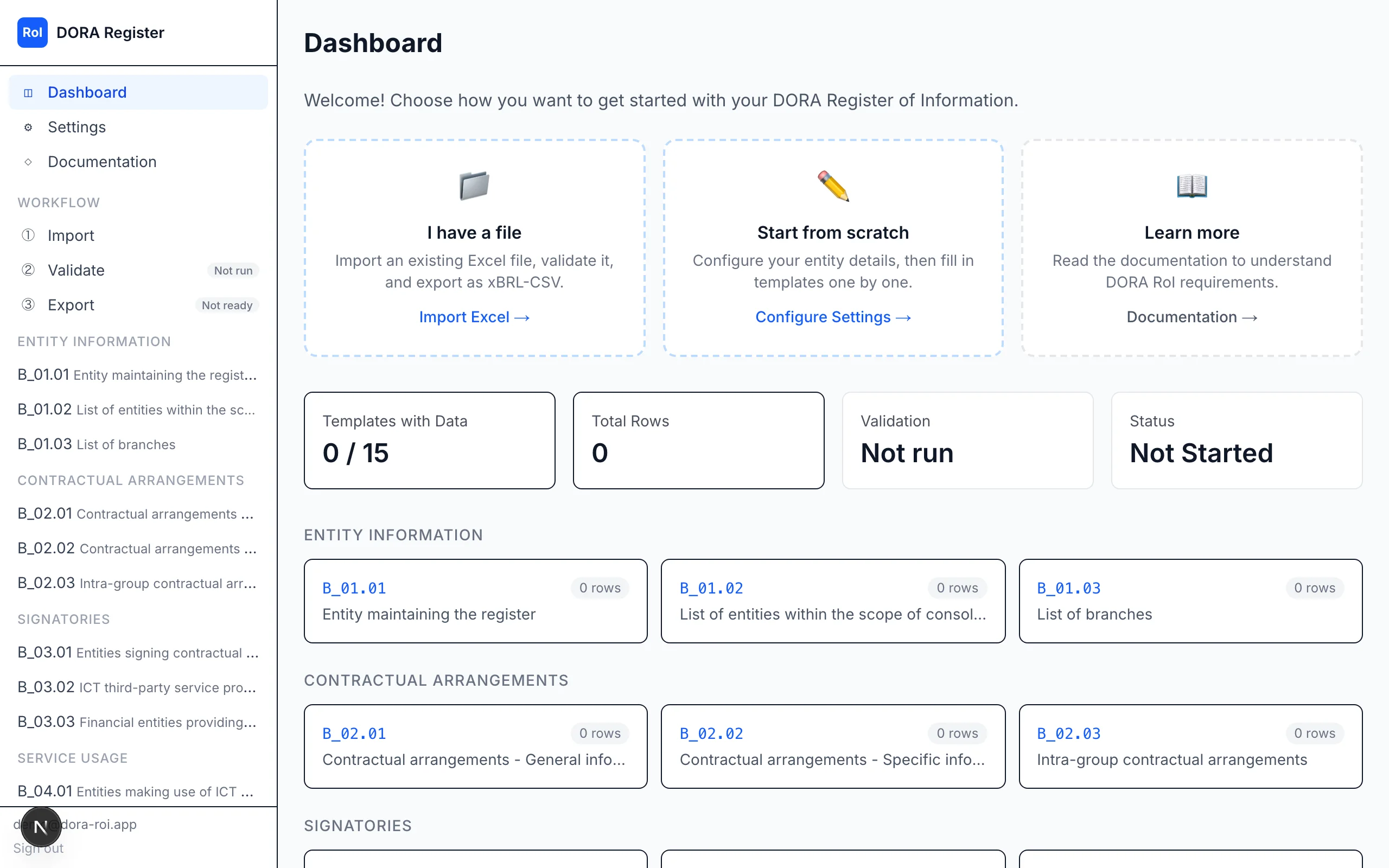
Excel Import
Bring your existing workbook. No re-typing, no data migration project. Your data stays exactly where you structured it.
15 Guided Templates
Fill every DORA template with taxonomy-based dropdowns, guided fields, and automatic code resolution. No guessing at EBA values.
4-Layer Validation
Technical checks, DPM format rules, DORA-specific logic, and EBA business rules — the same checks your authority will run.
xBRL-CSV Export
One click to generate the complete ZIP package in the exact folder structure and naming convention your authority expects.
YOUR CURRENT WORKFLOW
You've done the work. Now you need proof it holds together.
You've collected the data, filled the templates, mapped your providers. But without cross-template validation, you're submitting on faith.
Your ICT contract data lives across procurement spreadsheets, vendor lists, and contract management files. Nobody owns the complete picture.
The anxiety of knowing something is missing but not knowing what.
“It looks right — but will it pass?”
You filled the Excel templates, but there's no way to prove that cross-template references actually hold together. You're submitting on faith.
Frustration at being stuck between "too simple" and "too heavy."
You can't upload sensitive outsourcing data — provider names, contract values, sub-contractor chains — to a third-party cloud platform just to validate it.
“My CISO would never sign off on that.”
You signed off on last year's submission. Three weeks later, the authority sent it back with 47 cross-reference errors. Now your name is on the rework cycle — and the board wants to know why nobody caught it before submission.
“I can't afford to be wrong about this again.”
WHAT GETS VALIDATED
Four validation layers — the same checks your authority applies.
Every register is checked against the full EBA Taxonomy 4.0 rule set. Here's what each layer catches.
Technical & mandatory fields
Data types, formats, LEI structure, date ranges, text lengths, required fields across all 15 templates.
DPM & taxonomy codes
Closed-list values, foreign key integrity between templates, key uniqueness constraints per EBA DPM rules.
DORA business rules & EBA checks
Cross-template reference integrity, arrangement logic, branch codes, signatory requirements, and 91+ EBA-specific validation rules from ITS 2024/2956.
Average DORA compliance cost
96% of institutions estimated their total DORA compliance costs in this range.
Consulting for RoI validation
Per submission cycle. Manual review, no guarantee of passing all 116 checks.
DORA RoI validator
Same 4-layer validation. Same day. No vendor lock-in. Browser-only.
Deloitte European DORA Survey, 2025 · Industry estimates for Big 4 / boutique consulting RoI engagements
How it works
From import to export in one session.
Set up your entity
Define your reporting entity, LEI, and scope. Takes under 2 minutes.
Import or fill
Upload your existing Excel data or complete templates with guided fields and taxonomy values.
Validate everything
Run 4-layer validation: technical, DPM, DORA rules, and EBA business checks. See every error by template and severity.
Export & submit
Generate the xBRL-CSV ZIP in the exact structure your competent authority expects.
After validation
Walk into the board meeting and say “it's done, it's clean, here's the proof.”
That's what changes when you validate before you submit. Not just a cleaner file — peace of mind that your name is on a solid submission.
Know exactly what's missing
No more guessing whether your register will pass. See every error categorized by type and severity before you submit.
Hand over a structured package
Replace the fragile workbook with a properly formatted xBRL-CSV ZIP that meets EBA Taxonomy 4.0 standards.
Cut last-minute rework
Find and fix errors in your first session — not during crunch week when every rejection means another cycle of internal firefighting.
Keep sensitive data on your machine
Everything runs in the browser. Provider names, contract values, and sub-contractor details never touch a server. Your CISO stays happy.
Your questions
Doubts are normal. Here are straight answers.
"Why is it free?"
DORA RoI is a practitioner tool built by a working vCISO. It's part of the fromCISO ecosystem — designed to help lean compliance teams and demonstrate hands-on expertise. No paid tier, no upsell gate, no hidden cost.
"Is my data really safe?"
All processing happens in your browser using client-side JavaScript. No file uploads, no server-side processing, no cloud storage. Your register data never leaves your device. Read the security page →
"Will it catch what my authority checks?"
Validation is built on the same EBA Taxonomy 4.0, DPM rules, and business checks that competent authorities apply. Updated for the 2026 reporting cycle with reference date 31 December 2025.
"What if my Excel format doesn't work?"
The tool accepts the standard EBA template format. If your workbook uses a different structure, you can fill templates directly in the tool with guided fields and taxonomy dropdowns.
"I'm not ready yet — can I come back later?"
Yes. Your access doesn't expire. Start when you're ready — most users run their first validation the week they get access.
Alternatives compared
How teams handle the register today.

Andrey Gubarev
vCISO · EU Fintech Cybersecurity Expert · fromCISO · LinkedIn ↗
20+ years in EU financial services cybersecurity and regulatory compliance. Built this tool after watching lean fintech teams struggle with Excel-based DORA submissions — and after building and testing a complete EBA Taxonomy 4.0 validation engine from scratch.
Know your register is clean before you submit.
Run all four validation layers on your register data. See every issue by template and severity. Export a submission-ready xBRL-CSV package — all without uploading your data.
Enter your work email → get instant access to the validator
Prefer to talk first? Email andrey@fromciso.com or book a 15-min walkthrough